
By Robin Neidorf
Scroll down to request your review copy of our Ecosystems Assessment Matrix.
Our last post described Tangelo Tree’s Ecosystems Assessment Matrix - an evolving tool that enables us to examine social service ecosystems based on five factors: resilience, circulation, agency, connection, and comprehensive capacity.
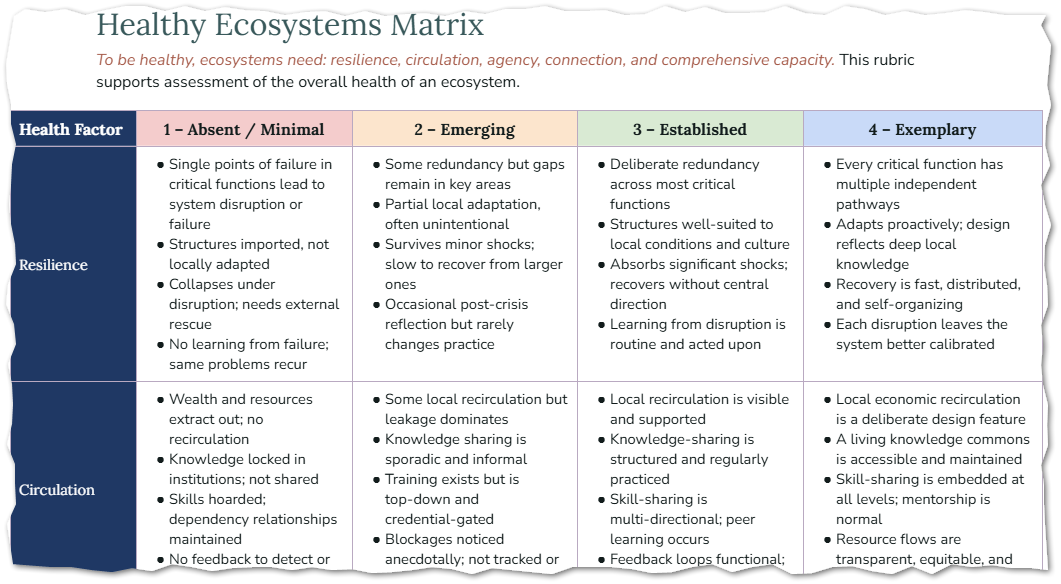
Extract from Tangelo Tree’s Ecosystem Assessment Matrix
Let's look closer at two of them: Resilience and Connection.
When a system has maximum resilience, every critical function has multiple independent pathways. Recovery is fast, distributed, and self-organizing. What’s more, the system doesn’t just rebound but actually gets stronger following disruption.
We often hear about the need to reduce duplication of services, but that isn’t always the most resilient stance. For example, multiple food banks may serve a given area, but one is a pop-up, another is mobile, and a third is fixed. And together they can shift and share resources (as long as they are connected and not competitive). A single entity would also be a potential single point of failure.
When a system has maximum connection, it is characterized by dense, diverse relationships that span sectors and communities. The relational fabric is institutional, not dependent on any one key individual. A great example of healthy connection in an ecosystem can be found in the Minnesota Democracy Defense Table, which brings together community-based organizations, labor unions, and public officials all with the common goal of protecting democracy and resisting authoritarianism.
In your experience, what’s one concrete example of ecosystem connection or system-level Resilience you’ve seen lately? We're looking for inspiration!
Would you like to review our full Ecosystem Assessment Matrix? We’d love to get your feedback! Please contact me at robin@tangelotree.org to receive a copy.
